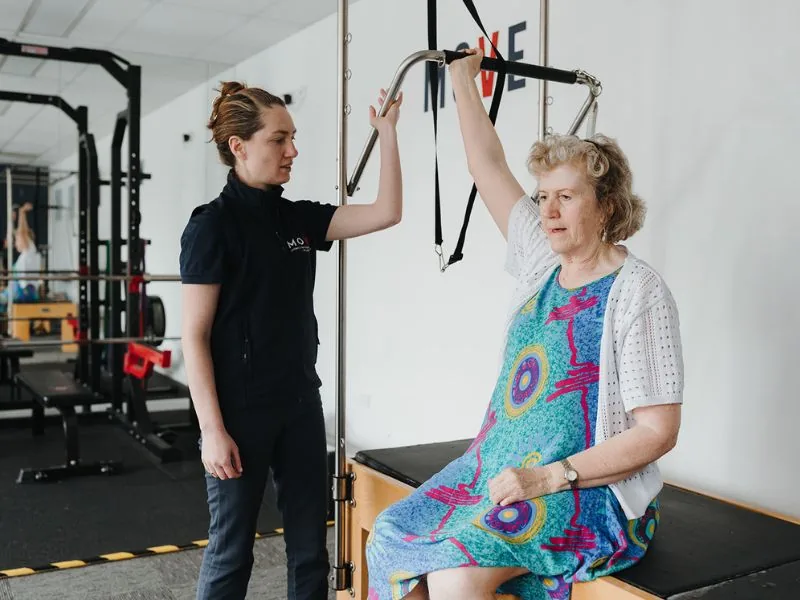
Most of my classes are made up of bendy people in some form. Not all diagnosed, not all severe, but they're there in almost every session.
And they're usually the ones who arrive carrying the most baggage.
Because by the time they get to you, they've probably been told they're fragile. They've been told to stop doing things. Someone has used the word unstable about their body, and they believed it, because why wouldn't they.
That's the actual problem you're solving. Not the joints.
Where clinical Pilates genuinely helps
This is one of the populations where I think it earns its place, and here's why:
- The equipment supports them while they learn. Springs give feedback that their own proprioception isn't giving them
- You can grade load properly. Small, controlled jumps, so they aren't guessing
- They can feel where they are in space. For a lot of bendy clients that's the missing piece, not strength
- It's safe enough to be brave in. They'll try things here they wouldn't try in a gym
That last one matters more than the rest. If they're scared, nothing you prescribe gets done. Getting them curious about their own body again is most of the work.
Where it lets them down
Now the honest bit.
If your hypermobile client is still doing supported work on a reformer six months in, you've let them down.
Bendy people need to get strong. Properly strong, with real load, in a gym, at rep ranges that actually build capacity. Clinical Pilates is where you start with them. It's a rubbish place to finish.
I say that as someone who sells a clinical Pilates course, so take it for what it's worth. But I'd rather tell you than have you keep someone on the reformer for a year and wonder why they're still subluxing.
The path looks roughly like:
- Supported, low load, learning to feel it
- Less support, more range, still controlled
- Loaded strength work
- Gym, weights, and eventually life
Every step is a progression you have to actively drive. They won't get there by accident.
Use the framework, not a hypermobility protocol
There's no special assessment for bendy clients. It's the same one you run on everyone:
- Red flags
- Range. Which will be plentiful. Range is not their problem
- Control and proprioception. This is usually where it falls apart
- Strength
- Function, and how it integrates
- Pain drivers, and there are often several
The answers change. The framework doesn't. That's the whole point.
What you'll usually find is that they've got heaps of range and almost no control of it, and everyone's been treating the range.
Stop telling them they're unstable
This is the bit I'd change tomorrow if I could change one thing.
The language we use with these clients does real damage. Unstable. Fragile. Be careful. Don't go into end range or you'll dislocate.
They're already frightened. Every time we say it, we make their body a scarier place to live, and a scared body moves worse.
Some things that help instead:
- External cues over internal ones. Push the bar away, rather than switch on your deep core
- Let them choose. Give them a harder and an easier option and let them pick, every time
- Name what's going well, specifically, out loud
- Talk about capacity, not damage. They're building tolerance, not protecting a broken joint
You're trying to hand them back ownership of their own body. That's not a soft outcome, it's the thing that makes them independent of you.
Plan for flares
They will flare. Not because you did something wrong. Because that's what happens.
The difference between a good clinician and a nervous one is whether you've already decided what you'll do about it:
- Know how you'll dial the load down without making it a crisis
- Have hands-on skills ready in a separate session if you need to settle things
- Tell them upfront that flares are part of it, so they don't read one as failure and disappear
If you haven't warned them, a flare will end the relationship. If you have, it's just a Tuesday.
One honest warning
This is a population where I do think you need to be a clinician, or be very well mentored by one.
Not because the exercises are complicated. Because you need to know what to do when you flare someone up, and you need to be able to rule things in and out. If you're not a clinician and you're doing specific rehab with a hEDS client, have a think about whether you're inside your scope, and check your insurance actually covers you.
That's not me being precious about the profession. It's that these clients get hurt by confident people who don't know what they don't know.
The takeaway
Bendy clients aren't a special case that needs its own recipe. They're a normal case that needs the framework applied well, with more attention to control than range, and much more attention to what they believe about their own body than either.
Start them on the equipment. Get them curious and confident. Then get them strong, and don't stop until they are.
It's not your fault nobody taught you this. Uni gave you the anatomy and skipped the part where you actually get them moving.
Have a crack with one bendy client this week. Change your cueing, that's all, and see what happens.
If you've got questions about how we teach this, just yell out, more than happy to have a chat. The Clinical Collective is free to join too if you want to see how we work before deciding anything.
Let me know how you go.